The shift to a circular economy is usually associated with increasing recycling rates or other forms of waste recovery as valuable material. European policy, too, has long directed most of its efforts towards waste utilisation, and the results are not insignificant. According to the latest available statistics, 44% of all waste in the EU (excluding volume-dominant mineral waste) was recycled in 2022. Including other forms of recovery, particularly energy recovery, more than 60% of all waste was processed in this way across the Union.
Striving for the widest possible use of waste is undoubtedly important, but it isn't enough on its own. Current trends demonstrate this: the growth in recycling rates has slowed in recent years, and European processors face weak demand for recycled materials, which are at a price disadvantage compared with cheaper primary and imported raw materials. Above all, however, recycling by its very nature only deals with waste once it has already arisen. It does nothing to affect the amount of waste that needs processing in the first place. And that amount is not falling.
Alongside waste utilisation, attention is therefore turning to waste prevention – ensuring that as little waste as possible is generated in the first place. This is, after all, a requirement placed on states, businesses and individuals by the European Waste Framework Directive, which sets out the so-called waste hierarchy. At its top stands prevention, followed by preparation for reuse, recycling, and other forms of recovery. European legislation is thereby stating that not all ways of dealing with waste are equally desirable, and that the best waste is the waste that never comes into existence at all.
But how can reducing waste production be achieved in practice, and can reducing waste output bring businesses any tangible benefits? And insofar as regulation plays a role in this, is it heading in the right direction?
Strategies for Waste Prevention
Waste prevention is often mistakenly reduced to a simple call to produce and consume less. More considered consumption is, in theory, one part of this, but it is neither the only strategy nor the dominant one. Other, more interesting approaches are available.
One of these is extending the life cycle of products. The aim is to manufacture products with a longer lifespan that are reusable and, in the event of a defect, can be repaired easily and affordably. A product with a longer life cycle only becomes waste later, making this one form of preventing – or rather delaying – the creation of waste.
Another strategy involves using fewer resources as inputs. This means considering whether the things we do could be done more efficiently – for instance, designing production processes more effectively, cutting back on excessive packaging, or digitising user manuals.
Prevention, then, is not primarily about "having less", but above all about handling materials more intelligently and efficiently.
Waste prevention is not only the most environmentally valuable strategy but also an economically rational choice. For manufacturing businesses, materials and their processing represent one of the largest cost items, averaging around 40% of total costs. More economical use of resources therefore translates directly into operational savings. It is estimated that waste prevention measures could deliver EU businesses net savings of up to 8% of their annual turnover. This comes alongside reduced dependence on price-volatile inputs and greater resilience against supply disruptions.
This is, however, largely untapped potential, held back by a range of market barriers – and appropriate legislation could help remove them.
Does Existing Legislation Reflect the Declared Priority of Waste Prevention?
For a long time, waste prevention was more of a declared priority in European legislation than one with any significant practical impact. Member states were indeed obliged to adopt so-called waste prevention programmes, but the tools needed to ensure such programmes were ambitious and genuinely implemented were lacking. That situation, however, is now beginning to change.
The clearest example of this trend is the Ecodesign for Sustainable Products Regulation (ESPR). This shifts the attention to the product design phase and allows EU-wide requirements to be set for product durability, repairability, and recycled material content. To prevent waste, the regulation also introduces a ban on the destruction of unsold textiles and footwear, which has already applied to large businesses since July 2026. The regulation thus pursues several avenues simultaneously in promoting waste prevention. Building on ecodesign, the Right to Repair Directive aims to extend product lifespans by making repairs more attractive, thereby delaying the point at which items become waste.
Another example is the 2024 revision of the Integrated Pollution Prevention and Control Directive (IPPC). Although it will likely undergo further adjustments as part of the ongoing Omnibus deregulation process, it is already clear that it will place stronger emphasis on material consumption and the volume of waste produced by large industrial installations. This may require upfront investment in modernising industrial operations, but in the long term it will typically generate significant savings for operators – whether in raw material and energy consumption, or in waste-management costs. In many cases, this need not be merely a saving but could become a new source of income: a by-product from production can serve as an input material for another operation and become tradeable on its own. Prevention and more efficient resource use will therefore be not just an obligation, but also an opportunity to cut costs and derive value from what would otherwise be disposed of uselessly.
What Will the Circular Economy Act Bring?
The draft Circular Economy Act is not due to be tabled until 2026, but the information available so far suggests it is unlikely to bring about a fundamental shift when it comes to waste prevention.
The declared aim of the Act is to create a single market for secondary raw materials, increase the supply of high-quality recycled materials, and stimulate demand for them. Among the tools under consideration are a reform of the criteria for determining end-of-waste status, and the simplification and digitisation of extended producer responsibility systems. Waste prevention tools are, therefore, not primarily on the agenda.
This is not surprising. The Circular Economy Act is intended to form one of the pillars of the so-called Clean Industrial Deal – the EU's policy on competitiveness and raw material security. Its central aim is to secure a reliable supply of materials for European industry and reduce dependence on imports, particularly of critical raw materials. For some of these, such as rare earth elements, the EU's import dependency is close to a hundred percent. A goal defined in this way naturally favours recycling, since it produces tradeable material – a "home-grown" raw material that can be offered to industry as a substitute for imports.
On the other hand, waste prevention can itself be considered one of the most effective strategies for raw material security. A raw material that is never consumed does not need to be imported, recycled, or disposed of, and a product with double the lifespan halves demand for the materials it contains. The competitiveness argument, then, does not lead only to recycling, but equally to prevention. This is not a conflict between economic and environmental interests, but rather a question of which circular strategy the legislator chooses to promote as the competitive one. Based on the information available so far, it appears the Circular Economy Act will place greater emphasis on the effective use of waste once it has already arisen.
Why the Right Strategy Matters
Waste prevention offers a range of advantages over recycling that go beyond environmental sustainability alone. Above all, it has an impact on costs. While recycling requires collection, transport, sorting, and energy-intensive processing – activities that carry non-negligible costs – prevention allows these costs to be avoided to a considerable extent. A raw material that is never consumed does not need to be extracted, transported, processed, or subsequently recycled or disposed of. It also reduces pressure on the search for new processing capacity, which is in short supply in some sectors. A business that builds its prosperity on longer-lasting products, achieving the same utility with less material, gains a competitive advantage and is very likely heading in the right strategic direction.
Equally important is the strategic dimension. The European Union is heavily dependent on imports from a small number of countries for a range of key raw materials, leaving it vulnerable to supply disruptions, price volatility, and geopolitical pressure. Recycling mitigates this dependence only to a limited extent, as for many materials it remains technically demanding and recycling rates stay low. Prevention, by contrast, acts directly at the source: the fewer raw materials an economy needs, the smaller its exposure to the risks associated with importing them. Lower material intensity thus strengthens the resilience of supply chains and bolsters raw material security – values whose importance has grown considerably in recent years. Waste prevention is therefore not only the most environmentally favourable path, but also the most economically and strategically far-sighted one.
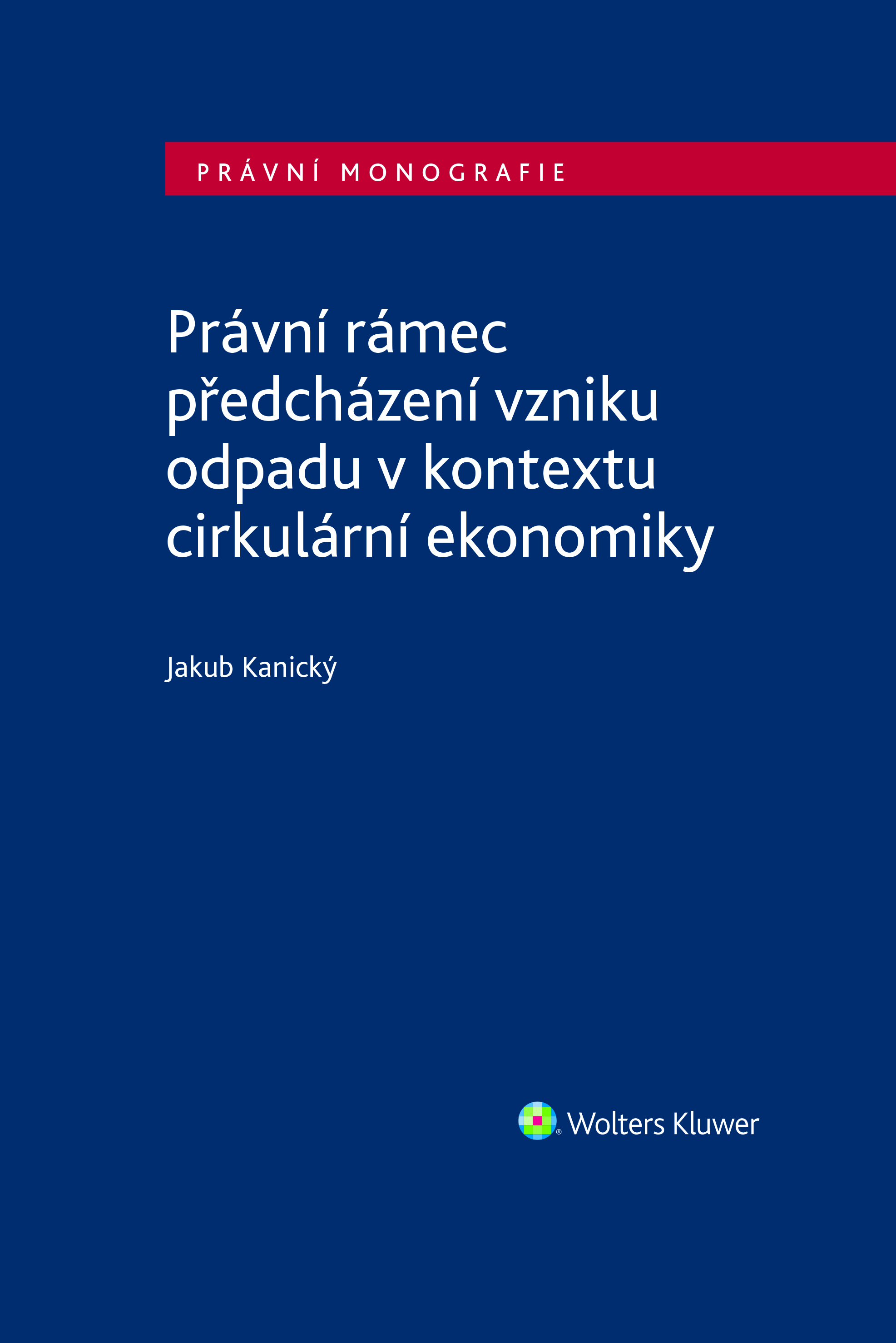
Developments to date suggest that the market ought to place greater emphasis on waste prevention than it has so far. What will matter, though, is not only the skill of businesses, but also whether we succeed in establishing a legal framework that genuinely prioritises prevention and removes the barriers businesses still encounter. A new book, The Legal Framework for Waste Prevention in the Context of the Circular Economy (Právní rámec předcházení vzniku odpadu v kontextu cirkulární ekonomiky), examines in detail where exactly European law departs from its declared priority and how this might be remedied. It is currently the only publication on the Czech market to offer a comprehensive legislative analysis of the transition to a circular economy.
KANICKÝ, Jakub. Právní rámec předcházení vzniku odpadu v kontextu cirkulární ekonomiky [The Legal Framework for Waste Prevention in the Context of the Circular Economy]. Prague: Wolters Kluwer, 2026. 212 pp. ISBN 978-80-286-0558-2.